


New York Gov. Kathy Hochul delivered her State of the State plan this week. One major plank in that plan is a proposal for at least 3.3 GW of new nuclear power on top of the 1 GW of public power-led nuclear development she’d already initiated. She calls it the “Nuclear Reliability Backbone.” As usual, New York’s staunchly antinuclear environmental left groups have something to say.
Bill McKibben’s Third Act and the Public Power NY coalition, led by the Democratic Socialists of America, are citing a new paper from a researcher at Penn's Center for Science, Sustainability, and the Media group to denounce Gov Hochul's plans.
The paper, “New York’s Nuclear Anti-Affordability Fiasco: Why the State’s Deeply Flawed Energy Plan Would Explode Electricity Rates” by Penn’s Joseph Romm, makes substantive mistakes and omissions. My rebuttals to some of his arguments, which are by no means complete, are below.
Faulty claims on AP1000 costs
Romm presents unrealistic cost estimates for the AP1000 nuclear reactor, the only large nuclear plant design that's on the table as potentially being built in New York, and the only nuclear plant design that has been built from scratch in America this century.
First, he asserts that "[a]ny new NY reactors are likely to cost the same or more than Vogtle’s." That is completely bonkers. Construction of Vogtle's first of two AP1000 reactors started before the reactor design itself was finalized. Not only that, the Fukushimi Daiichi accident in Japan led to regulatory changes that also required design and project changes mid-construction. But now two such plants have been built at Vogtle. The design is finalized and approved. Any new build project in NY would not suffer these first-of-a-kind problems.
Second, he disputes an estimate of $12,100/kW capital cost for another AP1000, a figure used by state agency NYSERDA as a cost assumption in its report Zero by 40 Technoeconomic Assessment. That's based on the high end of a 2024 estimate from a detailed MIT study specific to the AP1000 and the experience of Vogtle, and it bakes in cost reductions from various learnings in the construction since that project. But Romm disputes such reductions: "there’s no reason to believe there will be any learning gains" since Vogtle.
To argue the lack of any such learning gains in the AP1000, Romm cites a 2024 meta-analysis across technologies, which states, as Romm quotes, "It is important to note, however, that learning rates are not a guarantee on their own. Several countries have experienced little to no learning as more nuclear was deployed (e.g., the US)." But the very next sentence in the cited report qualifies that: "To materialize, learning needs to occur with a standardized design (with little or no variation between units), a consistent regulatory environment, and a robust supply chain and workforce." In other words, learning rates do materialize in the context of a standardized design like AP1000. In fact, a coauthor of this cited report, Koroush Shirvan, is the sole author of that MIT study focused on AP1000.
To summarize, Romm selectively quotes studies out of context in order to argue that new AP1000s in New York would absolutely not experience any reduction in cost since the over-budget fiasco of Vogtle, but the very research he cites to make these claims argue the opposite.
Demonstrably false claims about global nuclear plans
Romm paints a picture of nuclear as globally understood to be unnecessary. "New reactors grew so costly," he writes, "that every country in the world other than China has all but stopped building them." This statement is laughably false.
According to the World Nuclear Association's current count, there are today 73 reactors under construction globally; China leads with 37 but there are also construction projects in East Asia, South Asia, the Middle East, Eastern Europe, and Northern Europe. Aside from that, there are 117 reactors that are planned (i.e. approvals and funding committed, with operations expected within 15 years), across roughly the same widespread geography, including also 2 in Canada.


Faulty claims about renewable alternatives
Why pursue expensive clean firm power when solar plus batteries suffices, Romm asks. He quotes global clean energy think tank Ember as arguing: "Solar is no longer just cheap daytime electricity, solar is now anytime dispatchable electricity." Great, who wants to put them in charge of the grid? The absurdity of this statement is hard to overstate, as it flies in the face of modeling by grid operators across the country, particularly NYISO, which has spent years arguing in very explicit terms that this is absolutely not enough. Instead, NYISO argues, there is increasing, imperative need for "dispatchable emissions-free resources" which, they state, does not include battery storage and intermittent renewables like solar and wind.
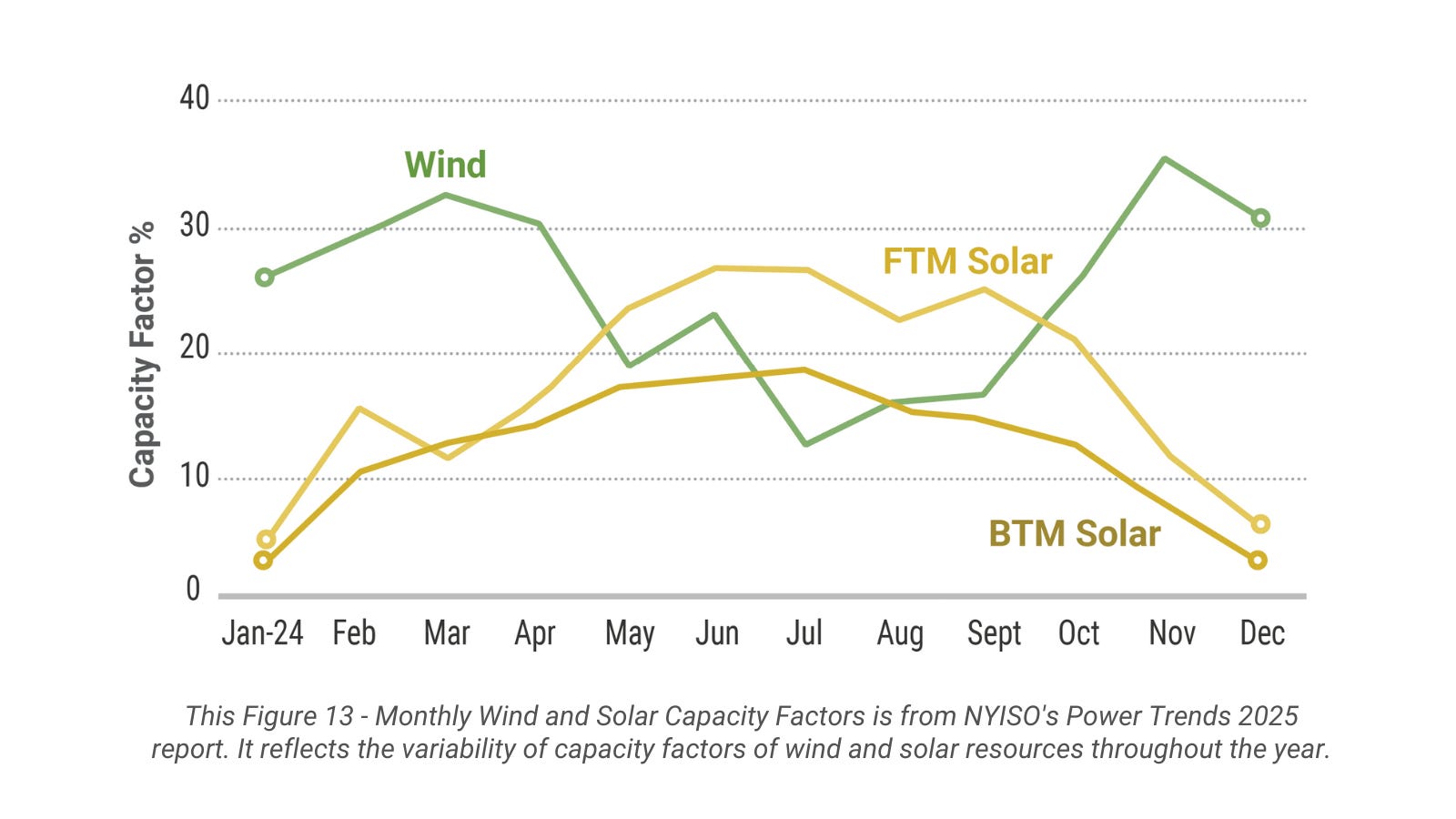
New York solar power's capacity factor currently fluctuates between 5% and 25% depending on the month, and likewise wind fluctuates between about 15% and 35%. Slapping 4- or even 8-hour batteries on that does not account for seasonal lulls -- at least not when you are planning a real energy system for a real society, and not just some green foundation-funded think tank's paper model. (Not to mention the very real battles over land use across New York State that such a profusion of wind and solar projects would exacerbate.)
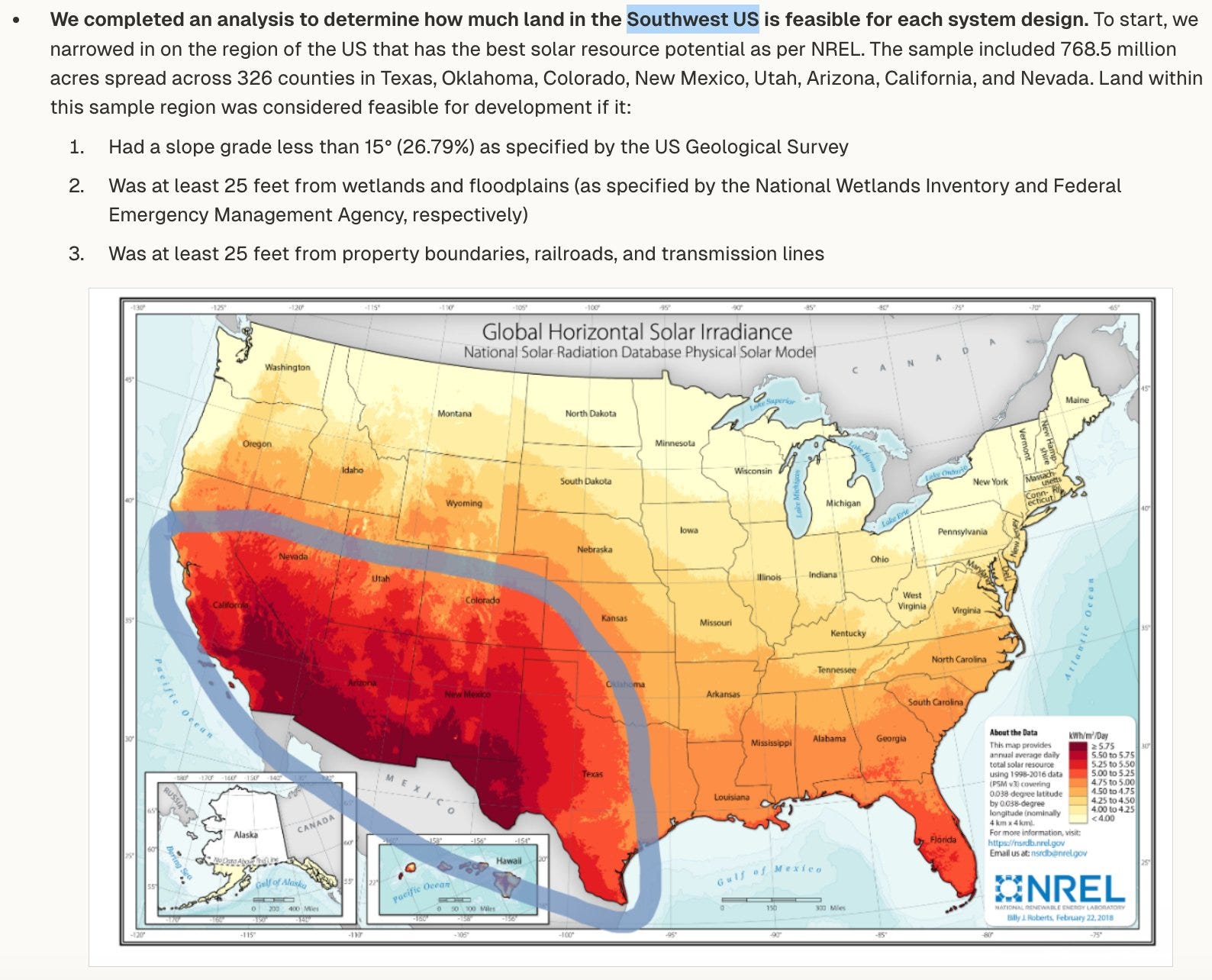
To aid his argument, Romm cites another study showing how solar and batteries can help power data centers off-grid for relatively low cost. What he doesn't mention is that the study was specific to the US Southwest, where land is plentiful, where the sun shines more often year-round, and where peak load on the grid lines up nicely with solar output (unlike New York, where the grid is increasingly experiencing peak load in cold winter mornings, especially as more heating is electrified).
Misrepresenting geothermal energy in New York
Another alternative Romm highlights is enhanced geothermal systems (EGS), which is indeed an exciting and promising source of clean, firm power, like nuclear. But Romm misrepresents its costs and its applicability to New York. He writes: "A 2025 Nature article found that by 2027, 'in the USA, enhanced geothermal is expected to achieve plant capital costs (US$4,500/kW)' ... It would be firm and potentially even dispatchable power 3 times cheaper to build than the Vogtle reactors." That sounds promising.
Unfortunately, he misrepresents the research. The Nature article in question does not find that cost estimate; it comes from the Department of Energy's 2024 "Commercial Liftoff" report for EGS. That low cost is not nationwide; it's specific to the best, easiest sites to explore with EGS — which are entirely in the West and Southwest — and assumed for the year 2030, after the industry improves from learning (an industrial effect Romm explicitly denies to further AP1000s).
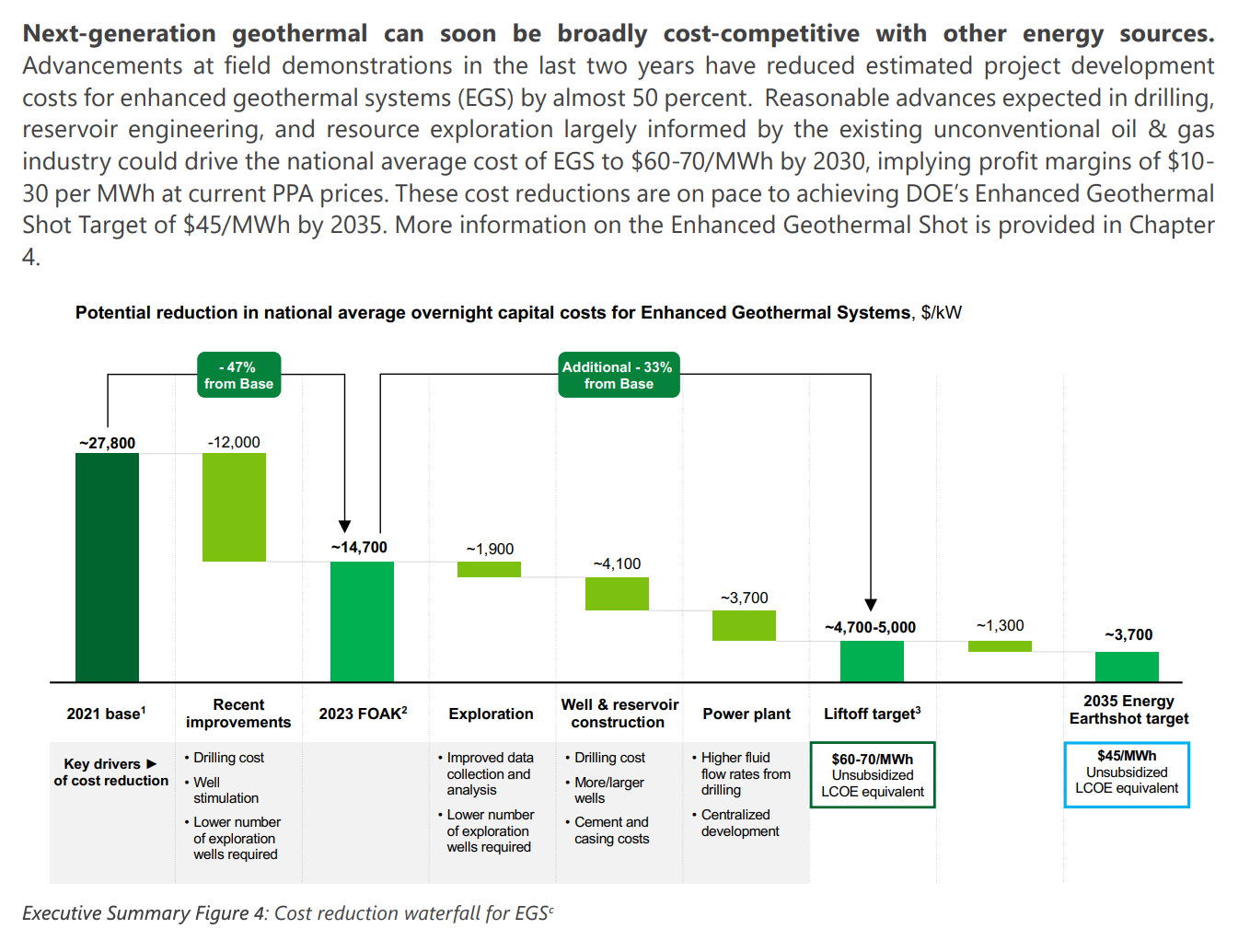
What would the costs be for New York? According to 2025 peer-reviewed research from Princeton, even under the lowest cost assumptions the capital cost is closer to $10,000/kW, with baseline closer to $15,000/kW. (There's also less potential capacity available.) That's because the geothermal temperatures needed for EGS are much deeper in New York than in California, where the estimated capital cost does indeed reflect the Commercial Liftoff report's figure. See their figures below showing capacity cost estimates by main electrical grid (New York lies in the Eastern Interconnection) and by region, where New York is highlighted in particular.


Romm cites this exact same Princeton study as stating "under baseline assumptions that EGS could plausibly contribute up to a fifth of total US electricity generation by 2050 and drastically reduce the cost of electricity decarbonization even in lower-quality resource areas east of the Mississippi—a much larger role for the technology than has been previously assumed." What the lofty promise omits, which is made explicit in the paper, is that the statement presumes after extensive learning in the EGS industry over the course of the next 25 years that we might have feasible technology to exploit the much deeper geothermal energy in places like Mississippi or New York. Imagine what 25 years of nuclear plant construction might do for its costs?
He also suggests geothermal energy behind the meter can satisfy data center demand growth (the source of all unaffordability, he argues). "A March study finds advanced geothermal could 'meet 100% of data center demand growth in 13 of the 15 largest markets' by early 2030s at low cost." Unfortunately here too he takes regional claims about the West, that absolutely do not apply to New York, and ... applies them to New York. That March study clarifies: "Among major growth markets, only Atlanta and New York City don't show meaningful promise for behind-the-meter geothermal." Oops.
Making a mountain out of a legalese molehill
Finally, Romm casts aspersions on the state's nuclear cost analysis by highlighting legal language in a contracted study. The state agency NYSERDA’s aforementioned 2025 Zero by 40 Technoeconomic Assessment was prepared by a third party (the Electric Power Research Institute) on behalf of NYSERDA. That report, he writes, "starts with an unprecedented disclaimer”:
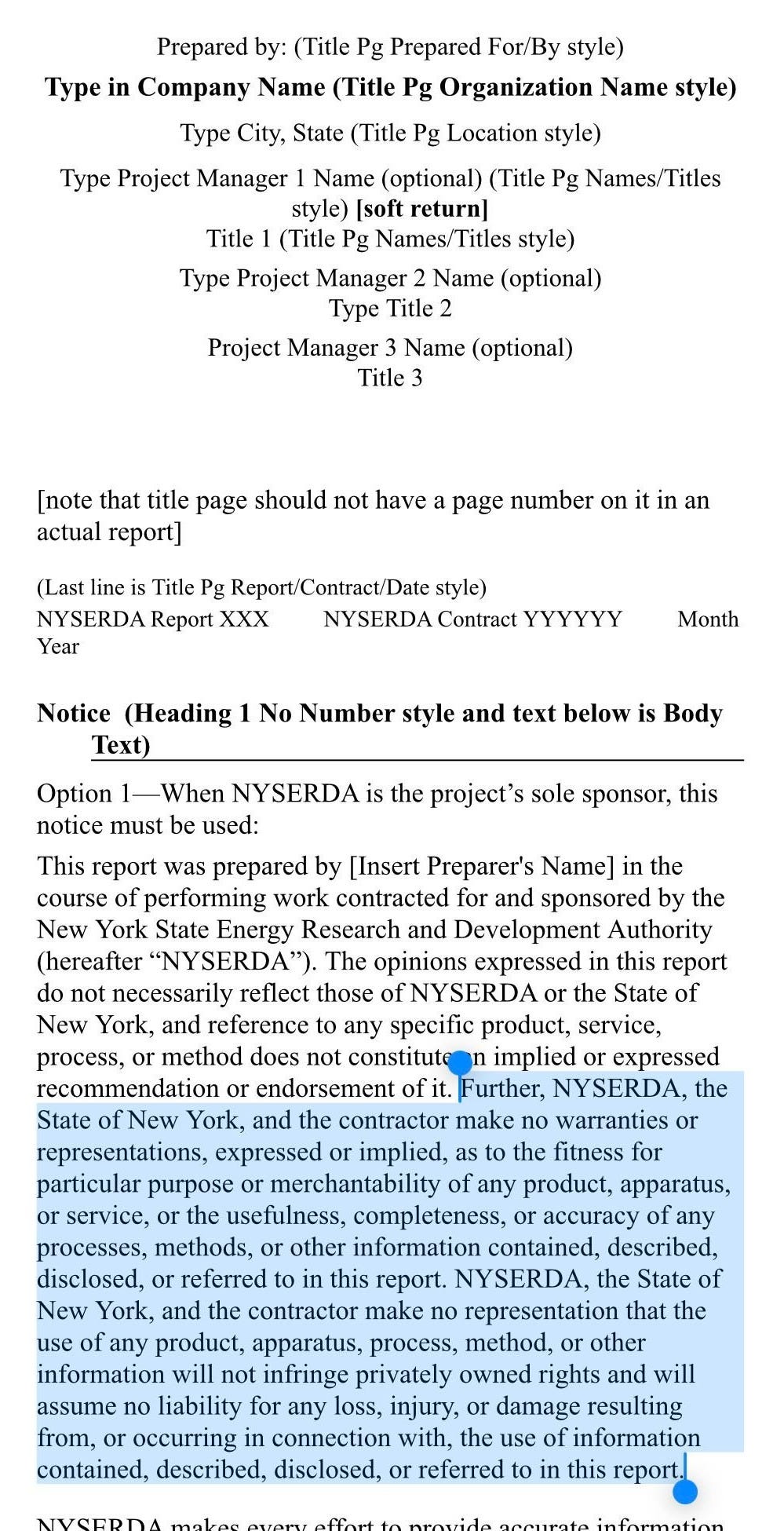
'NYSERDA, the State of New York, and the contractor make no warranties or representations, expressed or implied, as to … the usefulness, completeness, or accuracy of any processes, methods, or other information contained, described, disclosed, or referred to in this report.
‘NYSERDA, the State of New York, and the contractor … will assume no liability for any loss, injury, or damage resulting from, or occurring in connection with, the use of information contained, described, disclosed, or referred to in this report.’
“Since no one associated with the report stands behind its accuracy or the consequences of using it,” Romm concludes, “policymakers and New Yorkers should not use it as a basis for policy.
“The analysis in this paper confirms that conclusion. The findings are not defensible. Thus, the same is true of the Plan.”
But the language is far from “unprecedented”: NYSERDA writes exactly this language in its template for all such reports, pictured below.
The same language was also used, for example, in a 2014 report NYSERDA commissioned from a contractor, "New York Offshore Wind Cost Reduction Study," which in turn was cited in state reports on its offshore wind program. (Notably, offshore wind, which is itself very expensive, is not mentioned anywhere in the paper. That's despite its final energy cost to New York consumers approaching the ballpark cost of another AP1000.)
Romm is flat-out wrong about this legal language and is highlighting it disingenuously to scaremonger about the feasibility of the nuclear cost analysis.
Final thoughts
That's my read of the new study touted by New York's environmental left to criticize the prospect of new nuclear in the state (even the project led by the public power authority!). There's plenty more one could criticize in it; it's basically a screed of selective citations to scientific-sounding work that could be picked apart like how I did above.
In short, yes, nuclear is expensive -- and so are all the alternatives -- but there are good reasons to believe the costs of another large AP1000 reactor will come down, especially if planned as part of a fleet. As for SMR projects, that's another question, and perhaps there's more kernels of truth in Romm's criticism on that front, which I did not respond to.