

The Breakthrough Institute recently published a new two-part essay by me, “The Public Power Anchor,” as a continuation of their “stealth deregulation” dialogue. In this post I’ll very lightly summarize the main points of the essay but focus instead on some of the ideas that had to be left out for space. Go read the essay! Part 1 and Part 2.
The essay, in short
Almost everyone wants more interregional transmission and almost everyone blames utilities for its glacial expansion: from R Street, to the Niskanen Center, to the Roosevelt Institute, to the Climate and Community Institute. The Abundance camp places the blame instead on permitting, and most legislative efforts that aim to expand transmission train their focus on that side of the problem. But as the Breakthrough Institute’s Nordhaus, Alimento, and Wang recently identified, such efforts, like the Energy Permitting Reform Act of 2024, tend to smuggle in “stealth deregulation”: measures that force merchant competition onto the traditionally regulated electricity markets of America.
Progressives offer a cleaner solution to the transmission problem though: let the federal government build it. But wave the magic wand of abundance to conjure up such an authority on transmission and there’s a latent responsibility that merits far greater attention: the government has to play the umpire on the field. Which private projects deserve transmission help, what the benefits are worth, and how costs get allocated. The umpire needs to be trusted to call balls and strikes, but advocates of putting transmission expansion on the federal government seem only interested in what such a builder could be doing.
The umpire here has private interests in its ear that advocates should keep in mind: renewables developers for sure but more importantly the politically organized large corporate consumers, Big Tech in particular, who’d love for the government to socialize costs that enable their favored investments. Transmission advocates though only seem to recognize corporate interest on the utilities side of the field, the only side facing public service (profit) regulation.
Utility opposition to transmission projects isn’t merely reducible to shareholder protection. Nordhaus et al. found that public power utilities were some of the staunchest critics of stealth deregulation in permitting reform. TVA in 2010s, for example, rejected the Clean Line transmission project despite having no shareholders to enrich. In one Abundance-adjacent book the author lambasts TVA for this decision, calling it fossil fuel protectionism, without mentioning their flat demand, their public debt needing to be paid off, the balancing burden Clean Line’s wind power would have placed on them, or the absence of a private fleet of gas generators that would invisibly compete to perform that balancing in restructured markets. Therein lies the point of stealth deregulation, after all.
Today progressives, and especially myself, point to public power models introduced during the New Deal to guide contemporary efforts, like TVA. But this time the model I think we ought to follow comes from JFK, not FDR — the 1960s Pacific Intertie connecting Northwest hydropower to Southern California load along various utility territories. That project took three years of fighting over ownership, preference, and regional allocation before settling on segmentation: each utility owner built, financed, and recovered its own stretch, private utilities keeping their returns on equity, every proposal disciplined by the priced-out all-federal alternative the task force authored itself — as a “yardstick” in the sense of Rooseveltian public power.
What the Pacific Intertie development never had to fight over was whose resource deserved a line, because the resource was already public; never had to model speculative benefits, because Los Angeles wanted firm power by the megawatt; never had to allocate costs among rivals, because each recovered its own. The project freed itself of the umpire role and focused on the builder role.
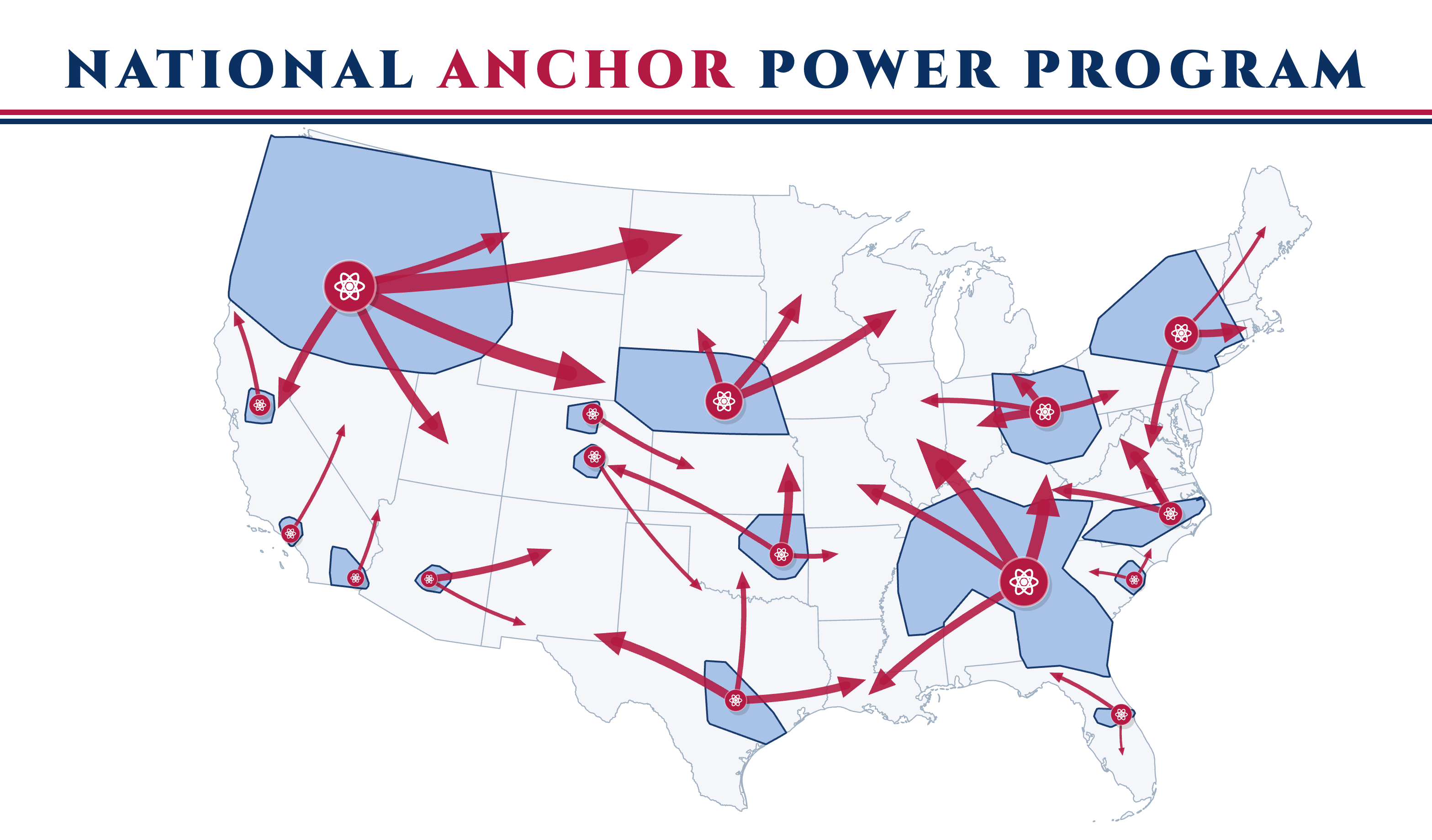
Part II of the essay applies that template to today. The resource has to be clean, firm, publicly owned, and welcome where it's built, which means nuclear, and the builder needs institutional capacity, which means TVA. A National Anchor Power Program builds federally supported reactors in a public power host utility and exports a share over HVDC into neighboring territory. Segmented transmission owners but one payer: the hyperscaler load in those neighboring utilities. The plant is built on the federal balance sheet and sells to TVA at a government-authored yardstick price, overruns falling first on TVA, then a hyperscaler reserve fund, then the government — cost overrun insurance for public builders only, not for those extracting a profit from it, as a new spin on the New Deal’s principle of public preference in power systems.
The program could start with fresh AP1000 reactors at TVA’s undeveloped Bellefonte nuclear site in North Alabama, with an anchor line delivering it to data center cluster in metro Atlanta. Public nuclear power, delivered over new interregional transmission lines to Georgia Power's system, as recompense for Georgia ratepayers after Vogtle, so that those ratepayers get the retail price depression benefits of large loads without financing massive power plants.
But public ownership doesn’t magically ward off local opposition, something progressive advocates must take into account. TVA itself has been rerouting lines and canceling generation projects because of it. That’s why the anchor program revolves around building transmission lines with clear public resources and public benefit. They’re anchored to nuclear power plants keeping the lights on — something conservatives in rural areas will be more likely than urban liberals to believe — and employing hundreds of workers for generations.
The anchor program needn’t be confined to TVA; Nebraska public power utilities and the New York Power Authority are all trying to deploy new nuclear too. And it needn’t be confined to nuclear; enhanced geothermal systems could provide the same clean, firm power without stealth deregulation in the West.
What’s not in the essay
The essay presents a critique of contemporary thinking around federally-supported transmission expansion, a history lesson on the Pacific Intertie, and a full policy program proposal in the National Anchor Power Program. That’s doing a lot of work — perhaps too much. The details of the NAPP architecture, which I spent over a month fleshing out in a series of Claude docs, simply couldn’t make it in, for example. For the sickos who want more details, you can read a condensed form of the latest version of that architecture here; warning, this doc is Claude, not Fred, authored.
So here I wanted to present a few stray ideas that didn’t make the cut or that just didn’t come out to well in my final presentation.
The anchor lines need a parallel reliability line adjacent to the firm power line, but the design and cost recovery of that reliability line gets tricky. The essay is a little mum on this idea but the gist is that if you want emergency power flow in both directions you need a separate HVDC line adjacent to the main one carrying the contracted firm power. The siting and rights-of-way of this line should be reused, but the expensive converter stations on each end would not be reused. Keeping it electrically separate also helps make the case for separate cost recovery. The kicker is, however, that the reliability line does not have cleanly divisible cost allocation, since the entire balancing area that it interconnects with benefits from the reliability it offers, rather than a particular utility territory and its customers. A lot more could be written on that.
The program expands public power without chartering new systems, but it still needs statutory changes to enable it. Don’t get me wrong after reading the essay; it would take some legislative work to enable the NAPP as I spell it out. The TVA would still need something done about that pesky debt limit I’ve written about. But it would also need a narrow carve-out to sell wholesale power outside its “fence”; it’s the narrowness — specific to the anchor program — that would keep it politically viable. The whole point is for the program to have buy-in from investor-owned utility neighbors, after all. More on legislative needs in the architecture doc.
Cost overrun insurance for nuclear builds is politically too ugly; here I try to mitigate that ugliness by confining it to public power only. The bipartisan Accelerating Reliable Capacity Act would tie a “meager” couple billion dollars in cost overrun insurance to the DOE EDF loans that projects would already be awarded. But after Vogtle, with cost overruns alongside shareholder profit being such a central focal point, it just seems wrong to put the overrun risk on public shoulders for what amounts to private gain. The ARC Act puts the yea or nay decision on government shoulders but the project cost development happens in the private sector. In contrast, my argument would be that the government works with the public power utility leading project development to come up with the project cost as part of a larger program of standardization; such a project would not be a one-off, and the intensive effort to plan the costs would be spread across multiple projects. The insurance would only be paid to a utility that is not collecting returns on equity investment or otherwise operating for profit.
TVA just announced other plans for Bellefonte, my suggested pilot project, but it could still fit the NAPP model. Since I wrote the essay, TVA announced that the undeveloped Bellefonte nuclear site would host a pack of GE-Hitachi BWRX-300 small modular reactors. My understanding is that they have no plan for financing except to get private help, for example, because of the debt limit. Despite not being an AP1000, the site could still serve as the anchor in the same way my proposal described. After all, they are helping to lead the standardization of the BWRX-300 already, and NYPA too has expressed interest in working with OPG on exactly that.
I’d love for people to read the essay and its National Anchor Power Program proposal. Feel free to email me with questions at fred@publicpowerreview.org.