

Back in June 2023, the trade group representing New York renewables developers, Alliance for Clean Energy New York (ACE NY), warned the state that, due to post-COVID supply chain issues and inflation, their 86 wind and solar projects under development were facing cancellation. That amounted to about 7.5 GW of new power generation at risk.
Each of the projects held a contract with NYSERDA, the state’s energy procurement agency, to receive subsidies in the form of renewable energy certificates (RECs), a project revenue stream on top of the actual sales of power. Having all competed for, and won, these contracts in annual auctions between 2016 and 2021, the developers were concerned the subsidies wouldn’t yield enough return on investment for their shareholders. The developers of four offshore wind projects and the ill-fated Clean Path NY transmission project all followed suit: our competitively won subsidies need to be increased.
To remedy their financial predicament and to save the projects, ACE NY requested that the state renegotiate their contracts by adjusting the REC prices with an inflation index. If the state refused their request then many of the developers would be forced to terminate their projects. But without these projects, ACE NY argued, not only would the state’s statutory climate goals be in jeopardy, so too would its electric reliability.1 After all, the only significant new power generation winning investment in New York these days is renewable.
New York needed the developers’ projects and therefore needed to increase their subsidies beyond the competitively determined contractual prices. The developers had the state under their thumbs and both sides knew it. Other trade groups and nonprofits that push renewable energy even backed them up in demanding inflation adjustments, as did labor unions, whose members’ livelihoods were predicated in part on building the projects.
In October 2023 the state’s Public Services Commission nonetheless voted unanimously to refuse the request for inflation adjustment to existing contracts. In a statement, ACE NY’s director Anne Reynolds painted a picture of doom and gloom. “Unfortunately, today’s action by New York is not a sign that our state is really committed to the climate change action mandates that exist in law, and it is not a day that has moved us forward in giving future generations of New Yorkers a healthier and safer environment,” she said.
But the state wanted to preserve competitive procurement as the way to develop new electricity resources at lowest cost to ratepayers. “By rejecting this relief, we signal to every vendor that our contracts, our commitments are worth the paper they are written on,” PSC Chair Rory Christian stated at the time. “We signal that ratepayer funds are not an unlimited piggy bank for anyone’s disposal.”
Instead, the PSC ordered a new, expedited 2023 auction for renewables subsidies, held shortly before the regularly scheduled 2024 auction.2 Any of those 86 projects that wouldn’t pencil for their investors under existing contracts could be cancelled, and developers could simply re-bid for subsidies in the new auction. Since they’re organized politically into a trade group that presses the state on the need for higher subsidies, they could be sure that the subsidies in the new auctions, a result of all their competitive bids, would be higher.
And that’s exactly what happened: a majority of these projects’ developers ultimately cancelled their contracts, re-bid in the subsequent auctions, won even higher subsidies from ratepayers, and continued with the projects.
The fate of the offshore wind projects that issued the same demand is better understood, given the smaller count. Each of the four cancelled their contracts and two of them won contracts for higher prices than what they’d won back in the 2018 auction. Empire Wind 1 gained a 27% increase in its subsidy, while Sunrise Wind scored a 32% increase.3
So how did the 86 land-based wind and solar projects shake out? To my knowledge, my analysis below is the first comprehensive look at what happened to each of the 86 projects that the renewables industry cited in its threat of cancellation. For the full details, check out this spreadsheet.
A majority of the threatened project capacity won contracts in later auctions
Of the 86 wind and solar projects that ACE NY demanded higher subsidies for, totaling 7.5 GW, a majority of that capacity, 4.1 GW, consisted of projects that eventually re-bid and won contracts in the subsequent auctions that NYSERDA ran. See the Project Roster tab in the spreadsheet.


20 of them (2.0 GW) won contracts, at much higher prices (see next section), in the late 2023 auction.
18 of them (2.1 GW) won contracts in the 2024 auction, whose price outcomes are not yet public.
8 of them (650 MW) submitted bids for contracts in the 2025 auction, which is still being evaluated.
6 of them (357 MW) continued to completion on their original NYSERDA contracts.
34 of them (2.4 GW) were simply abandoned by their developers, so far.
Notably, the developer AES disagreed with ACE NY’s request for renegotiated, adjusted contracts. It had one project in the 86, the 20-MW Silver Lake Solar, that it seems to have abandoned entirely.
Note that we can’t argue yet that a majority of the 86 projects won contracts after rebidding. The 2025 procurement auction is currently ongoing, so we don’t know which of the 8 projects from the petition set will actually win contracts based on their bids. In the 2023 auction, 48 of the 86 submitted bids but only 20 won, and in the 2024 auction, 25 of the remaining 86 submitted bids but only 18 won. See the summary tab in the spreadsheet.
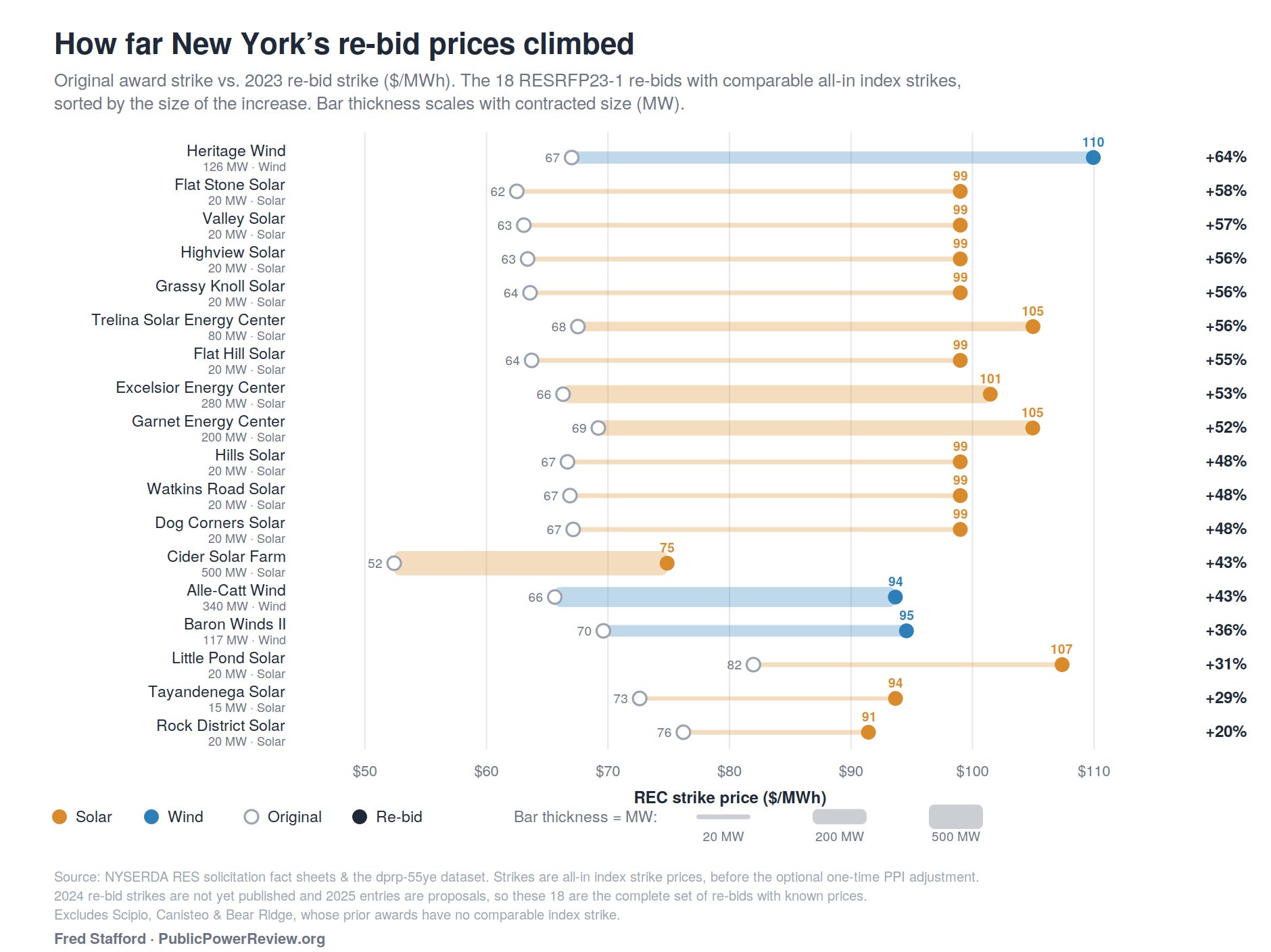
The ones that won contracts in 2023 scored subsidies that were 20 to 64% higher
So far, only the winning REC strike prices for the 2023 auction have been revealed, and it shows that the 86 projects that re-bid and won new subsidies in 2023 got exactly what they wished for: huge increases in the subsidy price. (The originally awarded REC price for two of these projects is omitted in NYSERDA’s data, so I left them out of the comparison below.)
The ones that won contracts in 2024 and later will almost certainly have scored higher subsidies too
The above price analysis was only on the subset of the 86 petition projects that won contracts in 2023, as the 2024 price data is not revealed yet (and the 2025 auction is not done yet). But the fact that not even aggregate price data has been revealed for the 2024 auction — unlike the aggregate prices revealed when the 2023 contracts were finalized — suggests that it does not look good, politically. In other words, it seems safe to presume that it will reveal still higher subsidy prices, and still more gain for those developers who canceled and waited for later competitive rounds.
How I did this analysis
Tracking the fate of the 86 projects in ACE NY’s petition can be done with NYSERDA’s data, but it isn’t straightforward to piece it all together. Projects show up with slightly different names, perhaps different developers, in periodic reports. One must use their NYISO interconnection queue positions and their state siting cases, both of which are included in state data, to track their progression over time.
Even determining the actual list of 86 projects requires some footwork, as ACE NY’s petition didn’t list them out.4 Because NYSERDA’s data hides earlier snapshots, I had to rely on lucky Archive.org snapshots of it to reconstruct that list. They’re all the land-based wine and solar Tier 1 projects from 2016 through 2021 auctions that were, at the time of the June 2023 petition, still listed as under development. See the “project roster” tab in my spreadsheet.
The rest was a lot of working with Claude to piece together the data and to determine the relationships between projects based on those technical identifiers, not just name matching. The resulting analysis spreadsheet can be used going forward to keep tabs on the still-unfolding fate of those projects — and of the political power of competitive developers who have the state by the balls.
Concluding remarks
The whole point of moving from utility monopoly to competitive markets for electricity generation was to lower costs by putting project risk onto investors and not onto ratepayers. Here we have a fully competitive procurement system and yet the investors managed to collectively exert some political pressure and shift the project risk back onto ratepayers. All it took was canceling their contracts, waiting for later auction processes, and acting collectively to bid much higher prices for those subsidies.
That’s because New York’s electricity system is not some testbed of pure competition, pure price signals, and autonomous, uncoordinated agents. The state has a grid that desperately needs new generation and it has climate goals that desperately need new renewable projects. The renewables developers have demonstrated their capacity to work collectively, through ACE NY, to push a narrative about their common industrial and financial situation. Of course it’s in large part true: COVID did create major new supply chain snarls and inflationary pressures.
But unlike in the old electricity market, where investment in generation came from the state’s utilities, the New York Public Services Commission has no corporate books to look at, no ability to regulate profits to ensure that investors aren’t making out like bandits. Instead, they can only trust the developers and read the tea leaves of the market, and hope that these iterations of competitive procurement aren’t producing huge windfalls for the projects’ ultimate investors. Maybe there was something important lost in that old way of doing things.
The ACE NY petition fleshes out the threat to reliability posed by the cancellation of their projects. Here’s an example: “… [D]elays in renewable energy development would only exacerbate the reliability risk already implicated in recent reports and undercut the State’s commitment to developing the resources necessary to effectively combat climate change.” NYPSC Case 15-E-0302, Petition of the Alliance for Clean Energy New York to Address Post COVID-19 Impacts on Renewable Development Economics and Contract Considerations (filed June 7, 2023, revised June 12, 2023), pp. 34-35.
The new auctions also included an optional inflation adjustment index that would apply to the final strike price once the project was finished with construction. This was a major ask from the ACE NY petition, and they largely got it.
See Table 5 in this research on offshore wind for a clear presentation of the New York offshore wind solicitations timeline and increase in strike prices. Hansen, Tyler A., et al. "Institutional learning in the energy transition: The case of offshore wind in the United States." Energy Research & Social Science 131 (2026): 104475.
ACE NY characterized the 86 projects as the subset of the 117 Tier 1 land-based wind and solar contracts, from 2016 to 2021 procurements, that were considered “Under Development” as of June 2023. See Table 14, NYPSC Case 15-E-0302, Petition of the Alliance for Clean Energy New York to Address Post COVID-19 Impacts on Renewable Development Economics and Contract Considerations (filed June 7, 2023, revised June 12, 2023), Attachment A, pp. 23.