

RENEWABLES ABUNDANCE IN TEXAS IS LOWERING PRICES! WIND, SOLAR, AND BATTERIES TO THE RESCUE! ...
That’s what you hear from countless analysts fixated on promoting liberalized power markets as climate politics. Yes, wholesale “all-in” energy prices at ERCOT are falling in the past few years; yes, it’s remarkable how much wind and solar is on the grid; and yes, it’s cool that batteries are being deployed too.
But among all the cheerleading of competition and wholesale price signals, people are losing sight of the downstream retail prices that households pay. Not just that, these cheerleaders have, over the past few decades, made everyone forget that public utility regulation is a century-old institution for regulating profits and prices (and service quality) in the electricity sector.
Most recently, IEEFA, the renewables-only global green think tank, put out a quarterly newsletter highlighting the “record-smashing summer” in ERCOT, the grid area for most of Texas and America’s foremost example of electricity liberalization. In chart after chart, they show how their particularly constructed wholesale price metrics for summer months have declined between 2023 and 2026. The average daily peak day-ahead energy price in summer months has plummeted from its 2023 peak! Tell the people!
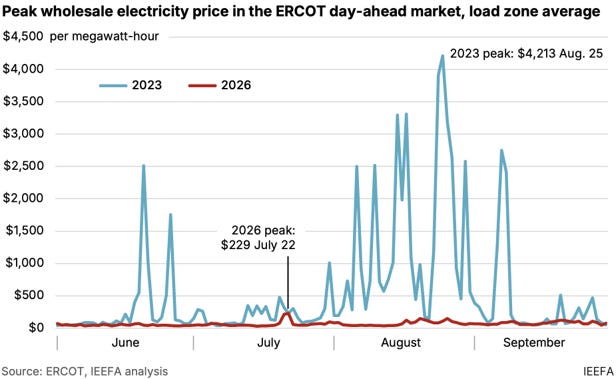
“Combined with dispatchable battery storage, renewables are not only providing power to the grid but also helping the whole system do so at low and stable prices.” IEEFA declares. “Texas continues to show that a reliable and economic transition away from fossil fuels is happening.”
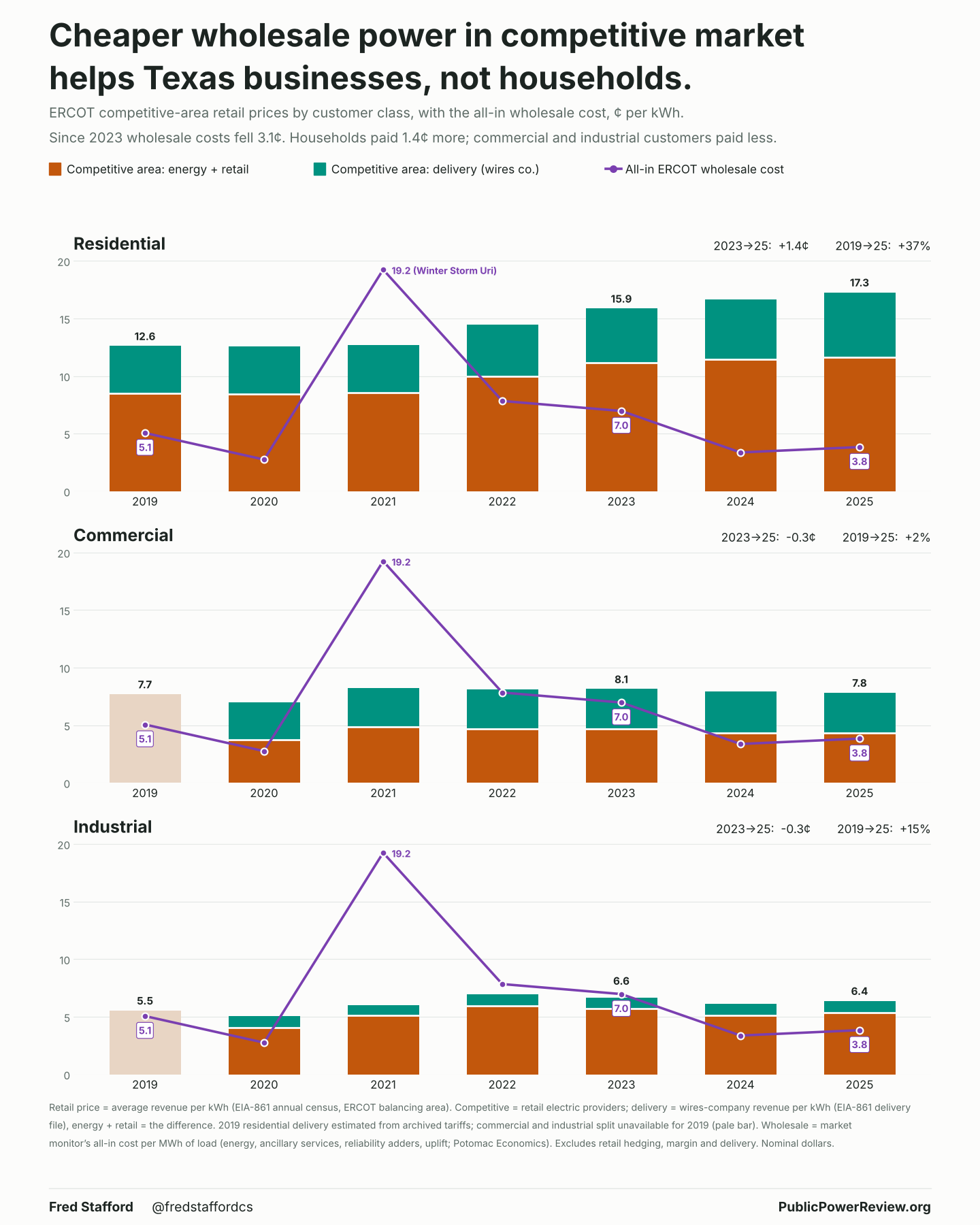
But what about the actual retail prices that households pay in the ERCOT part of Texas? Unfortunately, from 2019 to 2025, the latest available data, households have been paying more for their power. Businesses, on the other hand, with their far higher capacity for playing the market, have indeed reaped the benefit of the tightening wholesale power prices. Good for them.
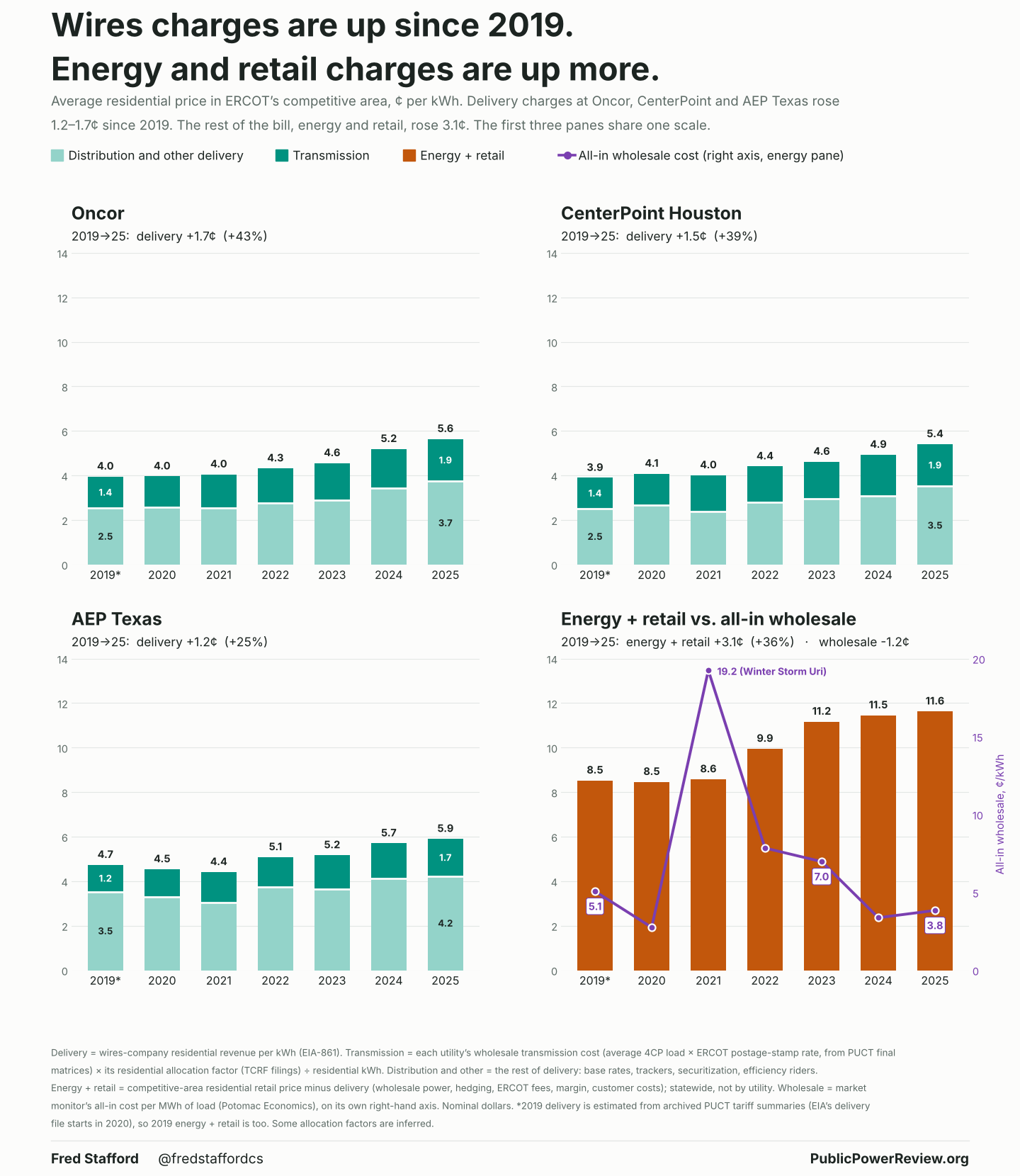
In this part of Texas, electricity is sold at retail by retail energy providers (REPs), which pass on the delivery costs (distribution + transmission) from the “wires” utilities. The delivery charges have indeed slightly increased, particularly the distribution part but also the transmission part — all that open transmission network ain’t free.
But the retail energy charges have increased too, despite the wholesale energy prices falling. That’s because the retailers are paying the cost of hedging on behalf of their customers. They’re also eating god knows what markup; we don’t know what their profit is because their prices aren’t set according to rate regulation by the state public utilities commission.
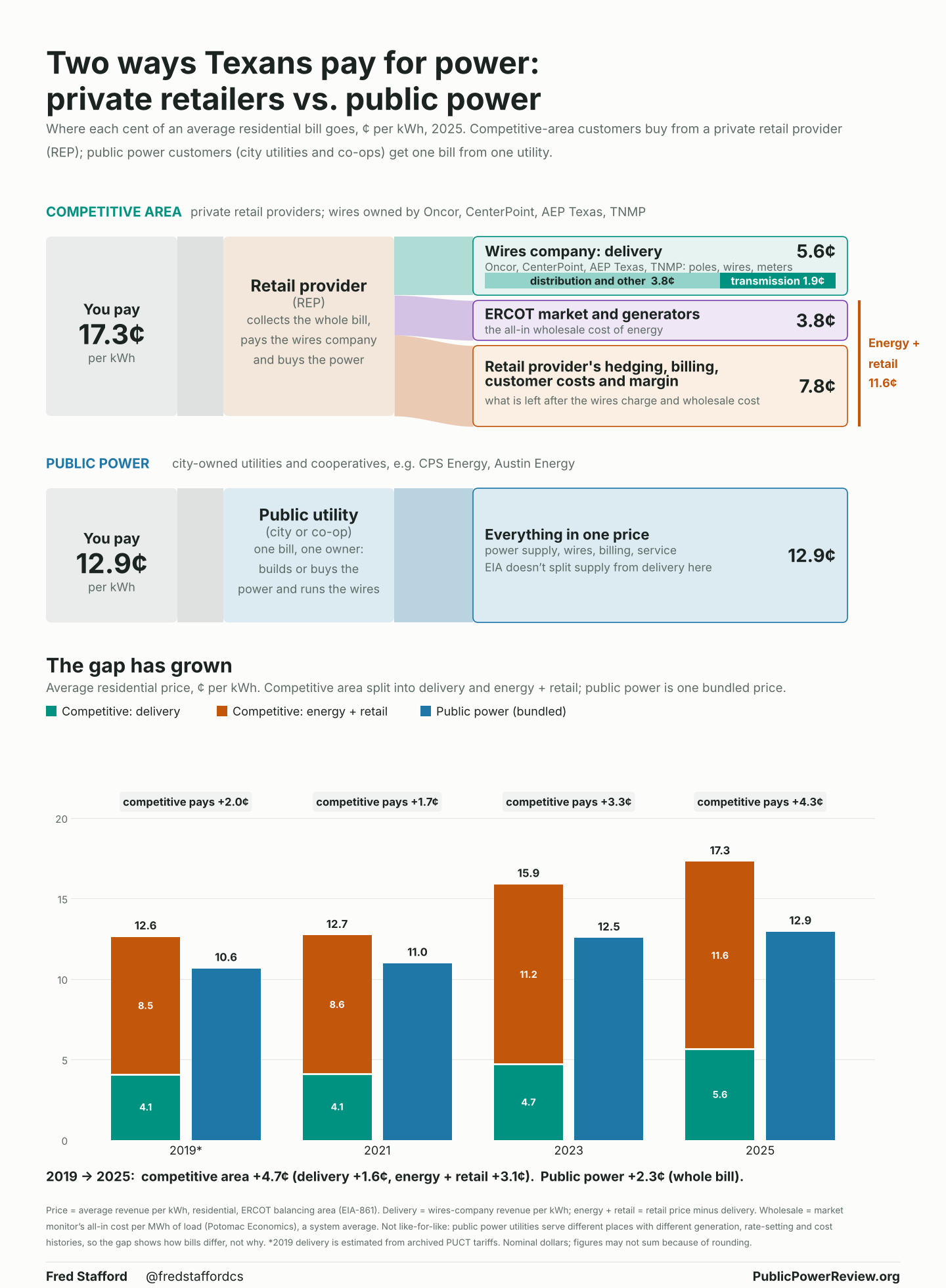
Meanwhile, if you’re in one of the public power territories, like Austin, San Antonio, and various other towns and rural counties — where the utility charges you the cost of service, without profit, for the whole stack — your retail price has stayed flatter. Indeed the residential price gap between competitive private power territories and public power ones has increased in recent years.
“Renewables go up! Batteries go wild! It’s the cheapest power imaginable!” So why are Texans paying more?
Maybe it’s time the public interest in electricity brings back some of those old-fashioned concerns about cost of service regulation of retail prices and profits, rather than cheerleading the perfect neoliberal wholesale markets that businesses, not households, benefit most from.