New York’s Clean Energy Competition is Failing
In a public comment to New York regulators, we argue that the state’s regime of competition is no longer working and that we must reconsider cost-of-service regulation to meet state energy goals.


In the long-running Case 15-E-0302 the New York Public Service Commission is wrapping up a biennial review of the state’s Clean Energy Standard. That’s the program that’s evolved to encapsulate the renewable portfolio standard, nuclear zero-emission credit subsidies, offshore wind program, and more. Below is the public comment that Matt Huber and I submitted to the case on Friday, October 13th. You can also access it online here. Many thanks to William Boyd for encouraging the comment, and stay tuned for a new essay from us and him
.
We submit these comments on the Draft 2026 Clean Energy Standard Biennial Review and on the Commission’s continuing review of utility ownership of renewable generation, which it opened in the May 15, 2025 Biennial Review Order and the January 27, 2026 Notice Soliciting Comments. We recognize that the formal deadlines for both have passed. We ask the Commission to consider these comments as it finalizes the 2026 Biennial Review.
We are an independent researcher and writer who covers utility regulation, and a scholar of energy and political economy. Our point is simple. For more than 25 years, New York’s industrial policy for electricity has revolved around competition among private developers to build new power plants. That policy is no longer working. It asks developers to carry risks they will not carry, and ratepayers pay for the mismatch in higher prices, in unregulated profits to investors, and in years of delay. Building new generation capacity under cost-of-service regulation, with the Commission’s prudence review, would be faster, cheaper, and more accountable.
1. The procurement model is not delivering
By the count of Fred Stafford, one of the undersigned, NYSERDA had contracted 20,688 MW of large-scale renewables as of September 30, 2026, counting each project distinctly and going back about a decade. Just 7% of that capacity is operational today. Another 14% is under construction and 21% is still in development. The other 58% has been cancelled. The chart below breaks this down by solicitation round; it and project-level data are available online.1
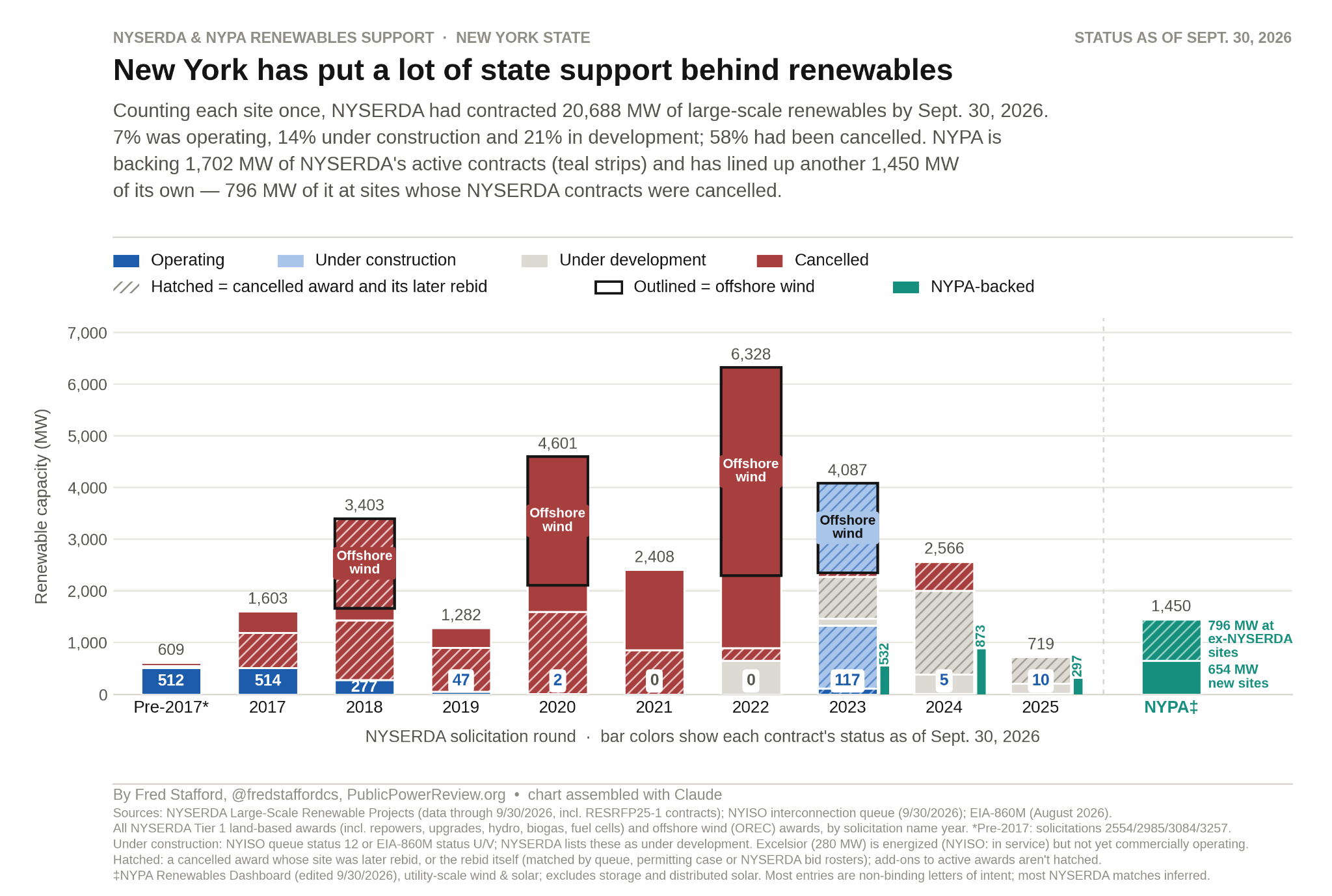
Many of those cancellations were not abandoned sites. They were projects that walked away from one contract and bid the same site into a later round at a higher price. Offshore wind shows the pattern most clearly. Every contract from the 2018, 2020, and 2022 rounds was cancelled. The two projects now under construction, Empire Wind 1 and Sunrise Wind, are 2018-round projects that gave up their contracts and won new ones in 2023 at strike prices roughly a third higher: $155 per MWh for Empire Wind 1, up from about $118, and $146 for Sunrise Wind, up from about $110.2
A program that cancels more capacity than it builds is not a functioning market. It is a cycle of bids, cancellations and rebids, and each turn costs New Yorkers time the Climate Act does not give us. Notably, the New York Power Authority’s renewables dashboard lists another 1,450 MW of utility-scale projects outside NYSERDA’s active contracts. About 796 MW of that sits at sites whose NYSERDA contracts were previously cancelled. A public entity is already stepping in where the private model faltered.
2. 2023 was a capital strike, and ratepayers paid anyway
In 2023, developers holding signed contracts asked the Commission to raise their prices. ACE NY petitioned on behalf of 86 onshore projects, and all four contracted offshore wind projects filed their own requests. NYSERDA warned that the proposals would shift risks from developers to ratepayers.3 On October 12, 2023, the Commission rightly said no. The developers then withheld their capital until the state offered better terms. That is a capital strike, and we should call it one.
Fred Stafford, one of the undersigned, traced every one of the 86 onshore projects through NYSERDA, NYISO, and EIA data.4 He found:
Most re-bid rather than walk away. Of the 86, 46 re-bid into later solicitations, and all but two won new contracts. Another 34 were abandoned outright.
Little has been built. Three years later, only eight of the 86 are in service, by NYISO’s count. Six of the re-awarded projects have already been cancelled a second time.
The prices we can see rose by about half. The 18 projects that re-bid into the 2023 round with published prices won new prices about 50% higher than their originals. NYSERDA has not disclosed the strike prices of its 2024 and 2025 awards and publishes them only once a project begins operating, years after ratepayers are committed.
The Commission held the line on the original contracts, but ratepayers will pay higher prices anyway, for power that arrives years late.
Supply-chain and financing costs did rise, and developers need a fair return to build. But under the current model, no one can say whether the rebid prices recovered real costs or produced returns above what regulated utilities are allowed to earn. Neither NYSERDA nor the Commission reviews a winning bid’s costs or its developer’s return. Under cost-of-service regulation, the Commission would set that return in public and review every dollar for prudence.
3. Developers want ratepayers to take on still more risk
The industry’s answer to these failures is to shift more risk onto ratepayers. In its October 16, 2026 comments5 on the Draft 2026 Biennial Review, ACE NY asks the Commission to keep “[r]educing contract settlement risk by tailoring compensation to resource-specific production profiles and mitigating generators’ exposure to shape and basis risk” (p. 4).
The Index REC already moved wholesale price risk from developers to ratepayers. Each new request moves more. If ratepayers are to carry a project’s risks, they should get what cost-of-service regulation gives them in return: a lower, publicly set return, an open review of costs, and a share in the asset’s value after its contract ends. Today they carry the risk, pay a merchant’s return, and hand the developer the plant when the contract expires.
4. Competition also slows the interconnection queue
Relying on competition among developers also slows down grid interconnection. Each developer chooses its own point of interconnection, size and technology without knowing where its rivals will file. Those filings stay secret until the queue window closes. Yet a project’s interconnection costs depend heavily on where other projects land, so every developer is guessing, and every cost estimate is highly uncertain.
Developers with deep enough pockets manage that uncertainty by filing many speculative projects and expecting to withdraw most of them. That makes costs even less predictable. Each round of withdrawals changes the power flows and the upgrades the remaining projects need, which forces another study. Large clusters also take longer to study, and finding low-cost upgrades for all of them is hard. Projects that came online through NYISO’s queue in 2024 had spent an average of 7.4 years there.6 NYISO has itself warned that even its new cluster study approach suffers “[d]eficiencies leading to withdrawals that often trigger delays” such as “withdrawn projects requiring restudy/model updates.”7 And of the 86 projects in ACE NY’s 2023 petition, 37 have since withdrawn from the NYISO queue altogether.
The queue does weed out expensive projects, but at a steep cost in time. A planner that decides where new generation goes can match it to load and grid capacity from the start, size the upgrades once and avoid most restudies. Planning has its own costs, but if speed matters, the multi-round, high-attrition study process is a problem that competition itself creates. DPS Staff’s Clean Energy Zones white paper is a step toward planning where projects go. Cost-of-service ownership would finish the job: when the Commission directs what gets built where, the queue no longer has to referee a guessing game among competitors.
5. A better way: statewide cost-of-service ownership
New York’s clean energy policy is already statewide. Every load-serving entity pays for the Clean Energy Standard through statewide obligations, wherever its customers live. Cost-of-service ownership need not stop at utility service-territory lines either.
We propose that the Commission let utilities, and NYPA where it chooses, build and own renewables, nuclear and other firm resources the State needs, with these features:
A regulated return. The Commission sets the return on equity in public, as it does in rate cases, rather than leaving it buried in a bid price and market revenues.
Prudence review. The Commission reviews costs before and after construction, with cost caps or overrun sharing like those regulators have used elsewhere.
Statewide cost recovery. Costs are recovered from all New York ratepayers as a new component of retail bills.
Statewide sharing of the output. The energy is allocated evenly to customers statewide, reducing the kilowatt-hours each buys from its own supplier.
The last two features also solve a problem that has kept utility ownership off the table in a retail-choice state. A utility cannot easily charge supply-side investments to customers who buy from an ESCO. Allocating both the costs and the power to every customer statewide sidesteps that problem.
NYPA could serve as a builder, a financing partner, or a builder of last resort for sites that fall out of NYSERDA contracts, as it is already doing. (With its new experience in renewables development, it can also assist with prudence review.) Competitive procurement can continue alongside, where developers deliver. We do not ask the Commission to settle every design question now. We ask it to put this option on the table and direct Staff to develop it.
6. Our requests
We respectfully ask the Commission, in the final 2026 Biennial Review, to:
Report how many contracted megawatts have been cancelled and rebid, and compare each rebid contract’s price with its original.
Find that cost-of-service ownership by utilities and NYPA is an appropriate tool for meeting the Clean Energy Standard, with statewide cost recovery and prudence review.
Direct Staff to propose a mechanism for allocating the costs and output of such resources to all New York ratepayers, regardless of their supplier.
Direct Staff, working with NYISO, to plan the locations and interconnection of publicly directed resources, building on the Clean Energy Zones white paper.
Before shifting further risk from developers to ratepayers, require an analysis comparing that option’s cost with cost-of-service ownership.
Thank you for considering these comments.
Fred Stafford, Public Power Review, New York renewables 2023 strike analysis (workbook, data, code and charts): https://github.com/fredstaffordcs/new-york-renewables-2023-strike. His accompanying write-up: https://www.publicpowerreview.org/p/when-new-york-renewables-developers
Maritime Executive, report on the finalized offshore wind agreements: https://maritime-executive.com/article/new-york-finalizes-new-power-agreements-for-two-large-offshore-wind-farms
NYSERDA, comments on the 2023 petitions, p. 21: https://www.nyserda.ny.gov/-/media/Project/Nyserda/Files/Programs/Clean-Energy-Standard/2023/NYSERDA-Comments-Petitions.pdf
Stafford, New York renewables 2023 strike analysis, project roster and crosswalks built from NYSERDA, NYISO and EIA data: https://github.com/fredstaffordcs/new-york-renewables-2023-strike
ACE NY comments of October 16, 2026, Case 15-E-0302: https://documents.dps.ny.gov/public/MatterManagement/MatterFilingItem.aspx?FilingSeq=396256&MatterSeq=48235
Enverus, NYISO 2025 market update: https://www.enverus.com/blog/nyiso-2025-market-update-challenges-and-opportunities/
NYISO, 2026 Cluster Study Enhancements For Consideration, presentation to the Transmission Planning Advisory Subcommittee and Electric System Planning Working Group, slide 4: https://www.nyiso.com/documents/20142/56175427/07a_Cluster%20Enhancements%2020250105%20TPAS.pdf/1509d3e4-0b2e-d19b-e7e6-4271a8c1255a